
Remember Covid? Feels like a blur, doesn’t it? A global event that shut the entire planet down for the best part of two years. And yet when you reach for it in your mind’s eye, it’s hard to remember it all.
Lockdown blurs into lockdown. Months fold into each other. The thing that was supposed to define the decade has the texture of a half-remembered dream.
Remember DVDs? Before Netflix. Renting a film from a shop, holding the case in your hand, deciding for an entire evening on one thing and committing to it.
Remember landlines? A single phone in the hallway, ringing into the house, with no notion that a person could be reached at all hours.
Remember dial-up internet? The kind that made that lovely, welcoming screech just before you connected, making you feel like you were on the cusp of entering an exciting new world.
Now reach further back.
Remember walking down a street and not seeing a single person looking at a phone? More people walked with their heads up. They looked at buildings. They looked at each other. They made eye contact with strangers, and the eye contact occasionally turned into a conversation, and the conversation occasionally turned into a friendship, partly because nobody had a portable escape hatch in their pocket.
Remember, nobody was taking pictures? And if they were, they were using real cameras that made the moment seem really worth it. You went to a wedding, a birthday, a concert, a sunset, and you experienced it. The memory of the event had to live in you. There was no second version of the night in the camera roll. Whatever you took away was what was actually inside your mind when it ended.
Remember the pace? The slowness of everything? Sunday afternoons that stretched. A trip to a friend’s house that took the whole day because there was nowhere else you were supposed to be, no parallel conversations running in your pocket, no algorithm refreshing for your return.
People sat in cafés without reaching for anything. They waited at bus stops without scrolling. The boredom wasn’t a problem to be solved. It was just a texture of being alive.
People seemed more content. They moved more slowly. The speed of them, the unhurriedness, the absence of that thin permanent frown of someone half-checking something, was unmistakable.
That world existed inside one lifetime. Yours.
And it doesn’t feel like one lifetime ago. It feels like another civilisation.
La belle époque.
Something has happened to us.
The convenience has obscured the size of the trade. We are more powerful than any humans who have ever lived. We can reach anyone, find anything, learn any subject, build any tool, all due to high-speed access to the internet and everything it entails. The gains are real. I am not pretending they aren’t.
But we have lost something in our core to get there. We have become scatter-brained as an entire civilisation, constantly scratching an itch we can’t locate. Less patient. Less able to sit with a single thought. Less able to remember what happened to us last week, let alone last year. The texture of time has been stripped from our lives. We have traded depth for reach and assumed it was a free upgrade.
It wasn’t free.
The Hybrid.
I am not arguing for the landline era. Or dismissing the utility of these services. I do not want to go back to renting DVDs and waiting six weeks for a letter. I want to be able to connect to anyone from around the world. The convenience is real. But what I want is the parts of the old world that we accidentally threw out with the bathwater: the continuity, the patience, the long unbroken stretches of attention that made a week feel like a week.
A hybrid. The power of the new world. The texture of the old one.
This essay is my attempt to take both sides of the trade.
The part nobody takes seriously enough.
You open the app. You look up. Twenty minutes have passed, and they have left no trace. No memory, no residue you can point to and say: that happened, I was there. Pure deletion. The cleanest theft ever invented.
The deletion compounds. Days collapse into smears. The week ends, and you cannot account for all of it. The month closes, and you reach for the memory of it and find nothing solid to hold. You weren’t lazy. You weren’t doing nothing. But something is blurring the edges.
You were on the platforms and checked them all for a total of over five-hundred times in a single month and never considered it was abnormal because you weren’t counting.
The damage doesn’t stop when you put the apps down.
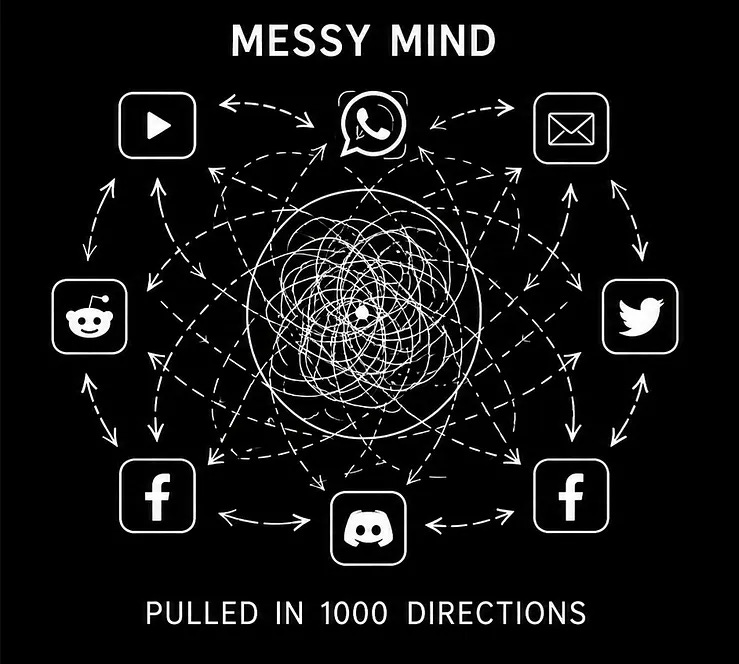
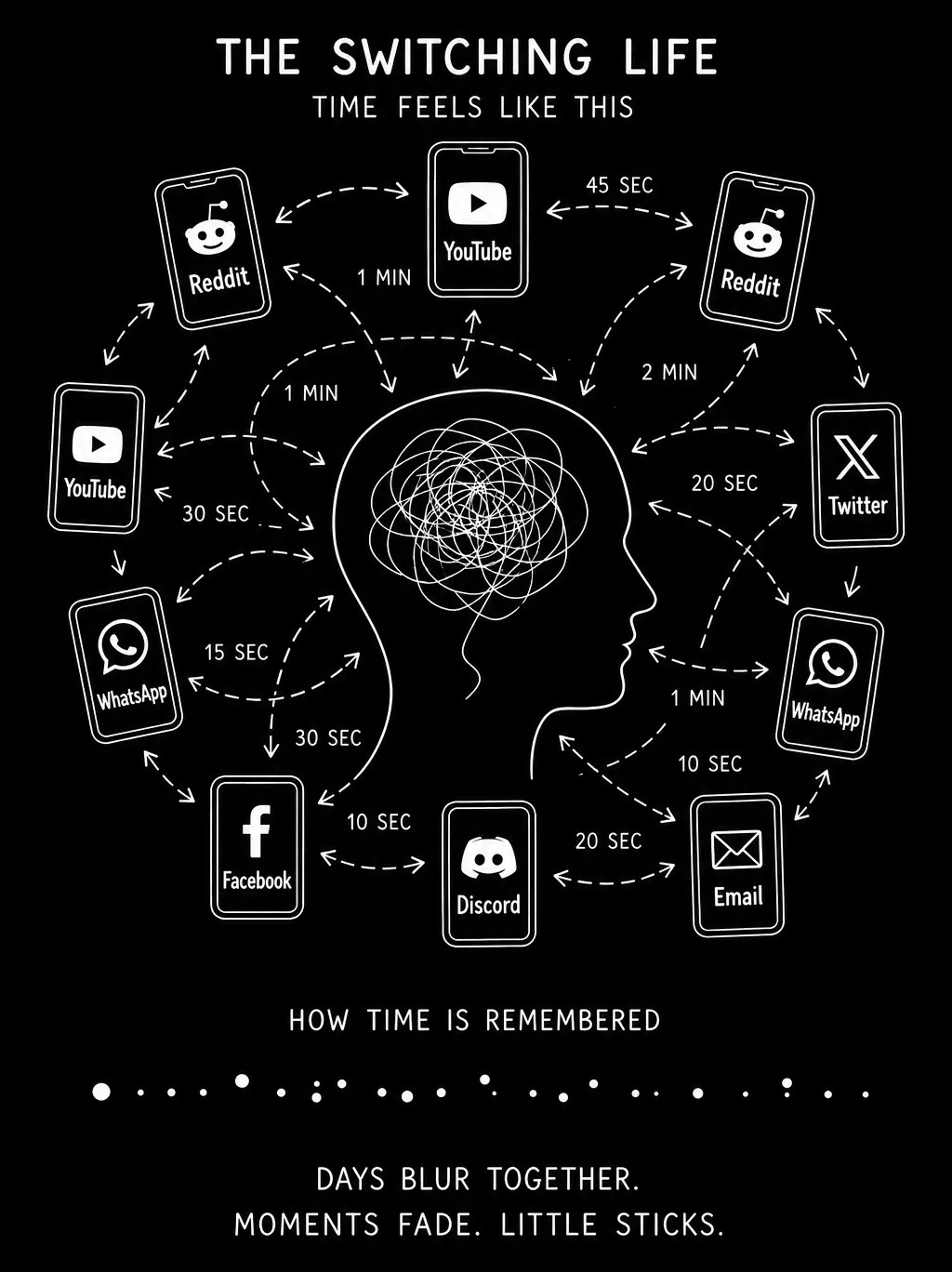
Every time you switch from the real world to the screen and back, your mind pays a tax. A piece of you stays on the last screen while the rest of you tries to function in the room you’re standing in. You are smeared across two places, owning neither. Do this ten to fifty times a day, for years, and something silently erodes.
The blur of constant switching is what destroys the texture of a day. This is more significant than the time you lost on the apps or sites. You are physically present at lunch but mentally on the message that arrived two minutes ago. You are physically with your partner, but mentally drafting the reply to the message you read but didn’t respond to.
The lunch dissolves. You think about the YouTube short you just digested. The conversation dissolves. The day dissolves. Not because any single switch was catastrophic, but because the repeated switching itself was the catastrophe.
The switching has stripped the texture out of time itself. Call it ‘Deep Time’: the kind that holds shape because attention was given to it long enough for memory to form. Deep Time is what your great-grandparents had and what you don’t.
These platforms don’t just steal your hours. They steal your sense of how many hours there were to begin with.
You are not getting older faster. You are remembering less of getting older. This is what is happening as our use of technology grows towards a compulsive direction. This is why the year you just lived feels shorter than the year before it, and why the next year will feel even shorter unless something changes.
The solution.
Step 1: simplify the playing field.
All email accounts collapsed onto one site, so no hopping between four inboxes like a man checking different doors for the same package. Reddit only via old.reddit.com on the web, which is the original interface and still the only one that doesn’t try to swallow you whole.
Browser extension installed to strip the feeds out of X, Reddit, YouTube, and Facebook. Every casino becomes a document. Visual demotion. Make them boring before you make them less accessible.
And that’s the first part.
Step 2: Bring in the wardens.
ColdTurkey runs on the computer. I’ve set it to block email, WhatsApp Web, Twitter, Reddit, Discord, Facebook, and YouTube four days a week. Total blackout. No exception.
AppBlock runs on the phone. However, the phone only has one social app installed: WhatsApp. For four days, it blocks access to WhatsApp, the Firefox Focus browser, and the Google Play Store. It receives a text. It has maps. And a calendar. And can play an audio file.
For four days a week, I can’t check any of the above services.
Step 3: Delete/deactivate some of your accounts.
LinkedIn and Instagram, both deleted and accounts deactivated. In case it doesn’t go without saying, no TikTok too. These are the worst offenders, the ones that strip-mine the soul most efficiently. You don’t moderate plutonium. They are gone.
The caveat: if you are a content creator or your work requires serious networking, those have utility you cannot easily replace. But they must be used exclusively on the computer with limited access.
Why this works.
These platforms are designed as curvilinear mazes. No corners, no endings, no moments where the path forces you to make a decision. Arthur C. Clarke wrote: “any sufficiently advanced technology is indistinguishable from magic”. The very basis for being able to contact someone across the world or access their videos is so incredible that it’s addictive in its own right.
But when you couple it with the cumulative, iterative tuning of the apps for maximum engagement, you naturally drift towards being a person on a moving walkway who forgot how to step off.
Tristan Harris, formerly a design ethicist at Google, alarmed by the impact of algorithms, put the stakes plainly in his testimony to the U.S. Senate: “What these companies are selling is not your data, it is the capacity to imperceptibly change your identity, beliefs, and behaviour”.
What they cannot defeat is a wall.
They hit it, the path ends, and you are forced into a conscious decision. Either wait until the wall comes down, or do something else. There is no smooth continuation, no soft gradient, no “well, maybe just one more.”
The wall doesn’t negotiate. ColdTurkey is a wall. AppBlock is a wall. Four days of total blackout is a wall four days strong.
What happens during the four days?
For four days a week, I am a baby.
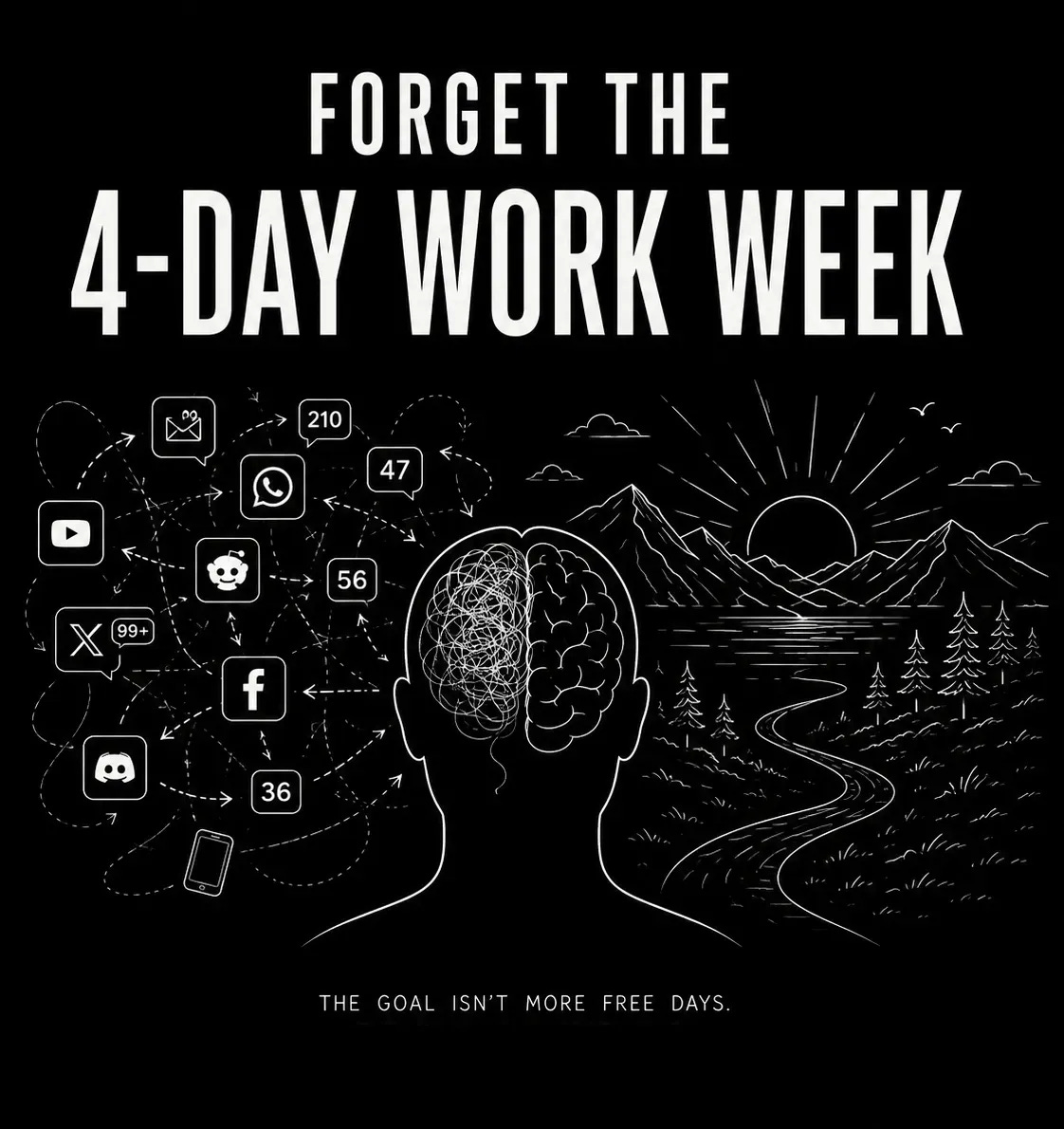
I am not a citizen. I have no identification, no inbox, no notifications waiting to confirm I exist. No one knows me, and I know no one. People speak of a four-day work week and how it would be a dream. I have a 4-day digital detox every week, and it’s better.
Old circuits start to reactivate. The dormant ones. The ones that caught my attention before the apps were installed in my head. The mind, given enough days, remembers what it used to do with itself.
It is a Tuesday morning in Qingdao. I have been off the platforms since Saturday. I am looking at the trees and seeing the leaves blow in the wind, noticing the subtlety of each leaf in its full geometry as each one twirls in its own uniqueness, while the tree is gently enraptured by the force of the gust. Nothing extraordinary is happening.
But it seems extraordinary. The watching is enough. I notice that I have been present for a long time without checking anything, and I notice that I had forgotten this was something a person could do.
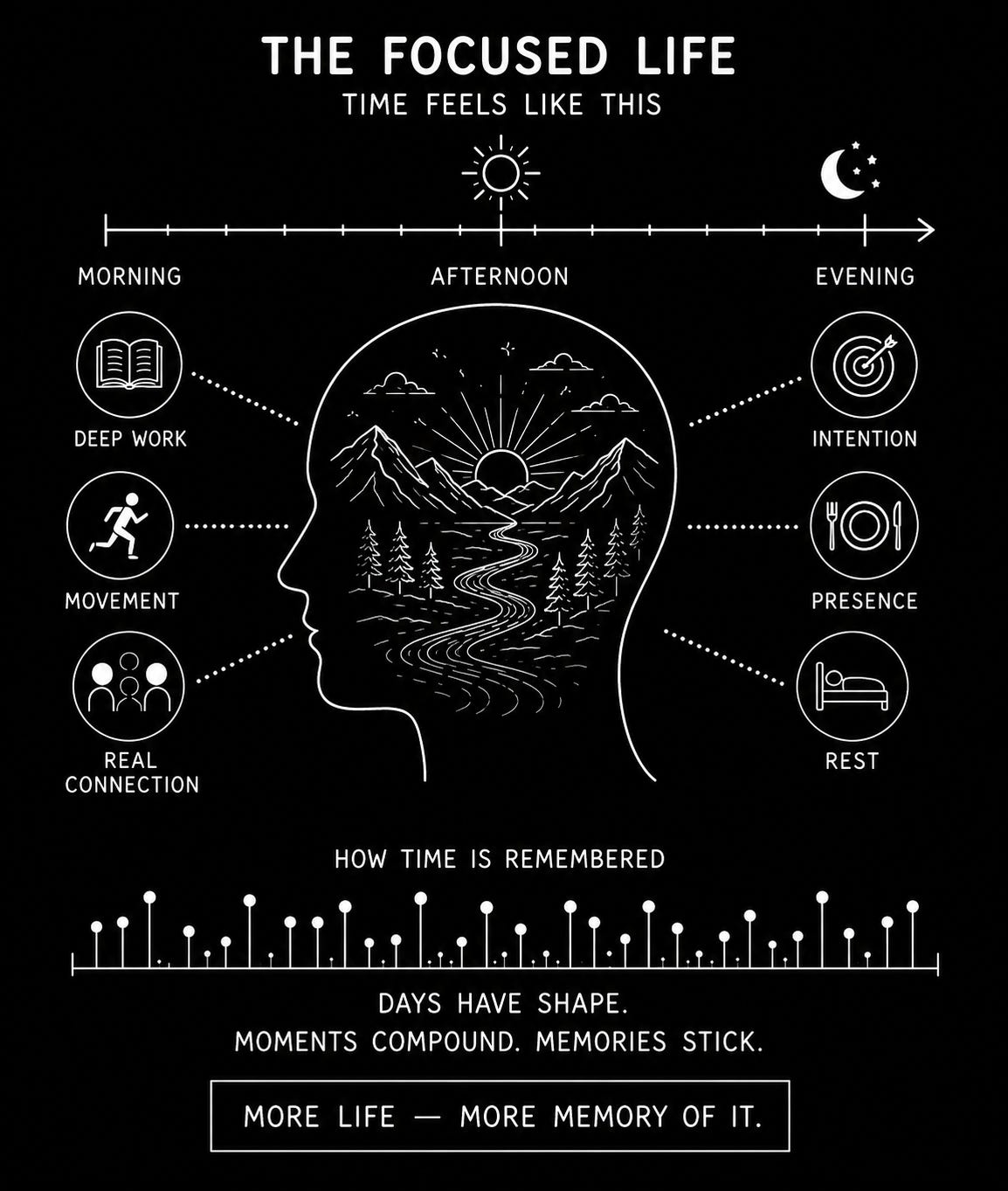
Time continuity returns. The morning connects to the afternoon. The afternoon connects to the evening. The day connects to the day before it and the day after. Nothing in the chain has been pulled out because there have been no intermittent digital compulsive checks, so the chain holds. A week feels more like a week. The old power, restored.
This is the thing that was missing. And I didn’t need to get rid of my smartphone to experience it.
Summary.
The unit that matters isn’t hours off social apps. It’s days.
For three days, I see what people have sent, I reply, I watch YouTube, listen to a podcast if something stands out, I reach out to people, take the conveniences of the modern world, and I use them. But it feels much more meaningful and enjoyable because it’s compressed into a shorter time-frame.
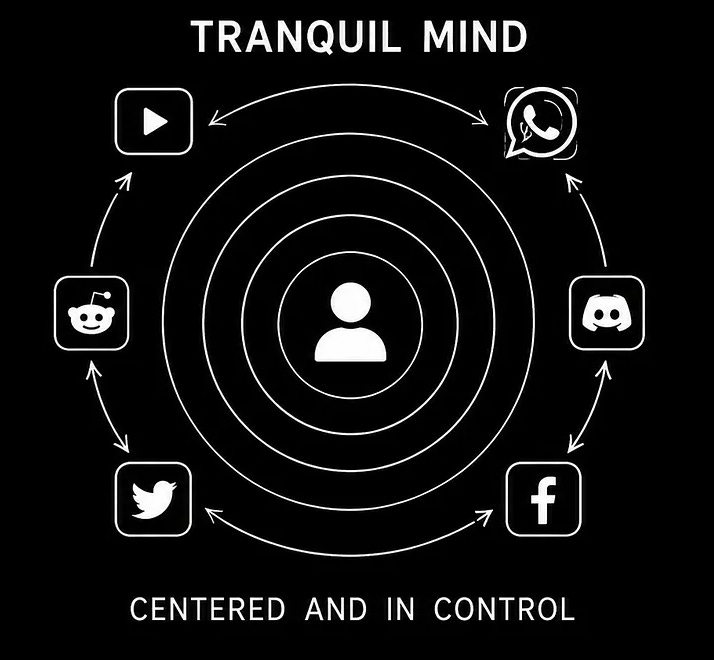
Then the wall comes down again, and I am a baby once more. I am not on the run. I am not in hiding. I am simply in my own world for just over half the week, by design, on platforms that were designed to make sure I never was.
This is the hybrid. Not the landline era and not the smartphone era. The power of the second, with the texture of the first.
This is not radical.
The radical position is the default one: leaving yourself open to every social app, all day, every day, and calling that freedom.
Further reading: My thinking on this topic was partly influenced by the following essays:
‘How social media shortens your life’ by Gurwinder
‘What happens when you stop consuming information’ by Ben Lucas
‘Unplugged & Unmedicated’ by Mehret Biruk
P.S: People speak of a four-day work week and how it would be a dream. They wait for something that might never come. Meanwhile, the thing they actually need, is available right now without permission, free of charge.
To end, here’s a song, titled ‘Deep Time’ inspired by this essay:
