
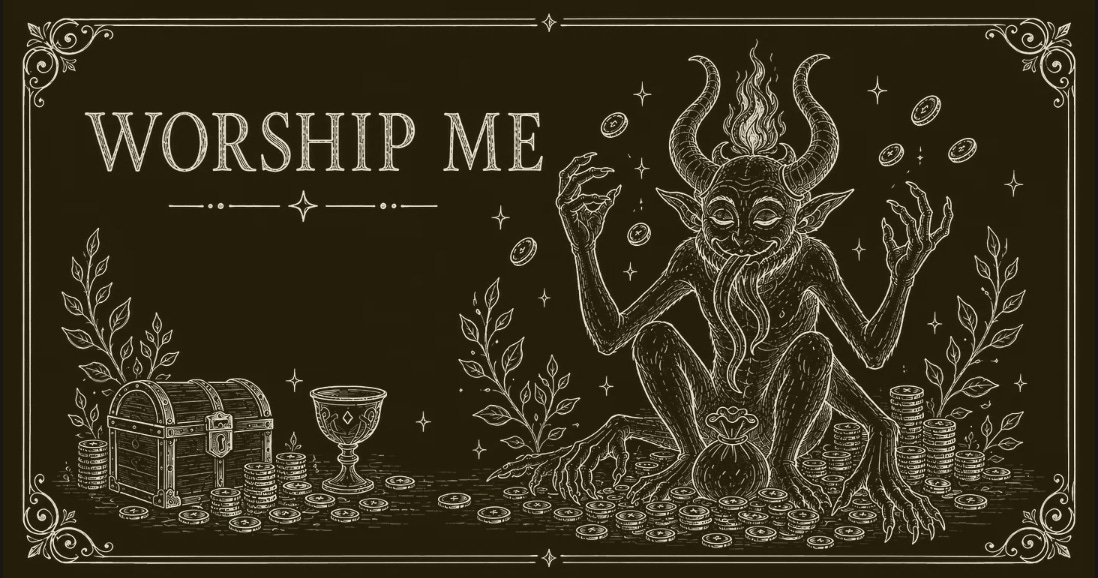
Imagine worshipping a God you didn’t know you worshipped. Imagine believing in a God who does not stand above you but underneath you. The opium of your thinking. The water you swim in. The O₂ you breathe. The fabric woven into your consciousness by the modern world before you were old enough to consent.
Most Gods require something explicit.
Mammon’s genius is that he does not.
Your belief in him is unregistered. The fish does not believe in water. The fish does not need to.
Water is all it has ever known.
The modern translation of ‘Mammon’ is “riches or money.”
The truer one comes from the Aramaic ma’mon: “that in which one trusts.”
The thing you bank on. The thing you hand your weight to before you hand it to anything else.
Mammon is often misunderstood as ‘capitalism’.
By the late 6th century, Pope Gregory the Great had codified the seven deadly sins. A thousand years later, in 1589, the German bishop Peter Binsfeld assigned each sin to a prince of hell. Mammon was given greed.
The naming was deliberate. Theologians saw a power. A presence. A hunger with its own agenda.
What he actually eats.
Mammon is not interested in your money. What he eats is more specific.
He eats the part of you that decides what is real.
You check your phone. For messages. Maybe a few reels. But also for numbers. Bank balance. Portfolio. Crypto. The number is up. You feel a small lift. The number is down. You feel a small drop. You do this often. Twice. Six times. Twenty times. In a single week. You do not notice the subtle sensations pulsing around your nerves when you do this.
You call it “staying on top of things”.
You do not call it worship.
Every refresh of your portfolio is a quick prayer. Every career plotting strategy is a sacrament. You perform the rite countless times and do not know you are operating under Mammon’s influence.
The currency you hold in your mind’s eye most often is the God you serve.
The inversion.
Consciousness was the original wealth. Awareness, attention, and presence all unfolded across hours that nobody owned. Money was designed as a mechanism to value the investment of consciousness into something over time.
Mammon’s central trick was the swap. The silent swap.
He convinced humanity that time is money.
Time was the substance. Money was the symbol. He flipped them.
Now money is treated as the substance and time as the convertible resource. You sell your hours to acquire the symbol, then spend the symbol to buy back fragments of the substance.
You never notice that the time you sold was the real wealth, and that the money you accumulated was the receipt for the wealth you gave away.
The receipt cannot be exchanged for the original.
This is the trick. And the sad truth.
Manipulating your self-worth.
Mammon’s second trick was manipulating your sense of self-worth.
You check your bank balance and feel something about yourself. You check your debts or lack thereof, and you feel something else about yourself.
You think about how much money you used to have or how little you used to have, and either way, you feel something about the fundamental nature of your ‘worth’ as it progresses through time.
You hear another man’s income and instantly rank yourself as deficient or superior.
You compare your net worth to last year’s and rate your life’s progress.
Notice the language. Net worth. The word for what you have has become the word for what you are.
You feel like you’re worth something when you have a lot of it. You feel worth little when you don’t have much of it.
The mirror appears to show you who you are.
But it’s only showing you what can be counted relative to the time and energy you put into becoming skilled at something in a marketplace that’s always changing. Or whether you’ve invested your money prudently.
Your self-worth has become externalised to the God of Mammon.
Your consciousness, the unique fractal of the universe that you are, and your inherent self-worth barely register as but an afterthought in your plot for acquisition.
Mammon’s mirror has only one core axis. You stare into it for decades and gradually shrink to fit the frame.
You want to get rich. To be special. To have a great life. And to do that, you’ve conflated money with so much of that promised life.
But there’s another reason you want more money.
Your inner world has been colonised. You take the demon’s measurement and apply it to your own soul.
How he became invisible.
Mammon was not always silent. For most of the Christian West’s first thousand years, he was named openly. Aquinas, one of the most influential thinkers in the history of Catholic theology, wrote against him in the 13th century.
For Aquinas, the threat of Mammon is not that wealth is evil. It is that wealth is the most successful counterfeit God, because it offers real power and real provision. The competition with God is genuine, not symbolic. That is why he writes about it with the seriousness of writing against a rival deity.
By the 18th century, Mammon had a new set of names. Commerce. Industry. Enterprise. Trade. Adam Smith, writing The Wealth of Nations in 1776, does not write about Mammon. He writes about the invisible hand, about self-interest, about the wealth of nations. The old God disappears from the discourse that organises his activity.
He was renamed into invisibility.
This is the genius. He needed to be unspoken. Once the activities that constitute his service could be discussed without reference to him, his victory became structural.
The most reliable form of worship is the one the worshipper does not recognise as worship.
By the late 20th century, the renaming was complete. The institutions matured. Money slipped its last tether to gold in 1971. Capital began to multiply itself with no detour through the physical world. By the time you were born, he was already everywhere, and the word for him had been retired.
You inherited a temple and were told it was a marketplace.
He is the air you breathe.
Walk through any city in the developed world. Almost every action you take is now a transaction.
This is what is meant by ambient.
Mammon no longer operates in discrete moments of exchange. He operates in the background of everything. The metric against which every action is silently calibrated.
This is the deepest victory. His power is not that he convinces you. His power is that you can be unconvinced, fervently, articulately, and still operate within him. There is no escape into purity. There is no domain outside his jurisdiction.
He is omnipresent not by being but by intermediation. Every gesture passes through him on its way to its object. Every relationship is mediated by his rails. Every choice has its price tag.
Fear is what keeps you inside.
Fear is Mammon’s central operating emotion. Not greed.
The man who measures himself in his coin is afraid of having less. The man who plans for retirement in his denomination is afraid of an old age outside his system. The man who works fifty hours is afraid that forty-five would not be enough. The professional who builds a personal brand is afraid of being unnamed in his marketplace.
Mammon does not demand fear.
He makes the alternative unthinkable and lets the fear arise on its own.
Two lives.
There is a life that uses money. And there is the life that is used by money.
In the first, money exists below the ledger of consciousness. You earn, spend, save, and give, all without your interior weather depending on the numbers. The numbers go up, and you are the same man. The numbers go down, and you are the same man.
In the second, money sits above consciousness. The numbers determine the weather of your soul.
Mammon hates the first life and loves the second.
The withdrawal.
Walk through any capital city at rush hour and watch the eyes. Most are gone. Not dead. Pledged.
The trust was transferred years ago. The body is just completing the contract.
The spell breaks at the point where you stop measuring yourself in the demon’s units. You still use the units. You still pay for things and appreciate what money brings. But you no longer take the demon’s yardstick to your own soul.
This is difficult work.
When you withdraw your measurement, the offering ends. Mammon does not get angry. He cannot. He is not a person.
He is a hunger that has lost its mouth.
Consolidation.
Some readers will mistake this for an anti-wealth essay. It is not.
Money is a tool. Wealth is great. Providing for those you love is great. Building something of value and being compensated for it is wonderful. There is no virtue in poverty and no purity in scarcity.
Mammon is not money. Mammon is what happens when money stops being the tool and becomes the measure of your soul. When the number on the screen sets the temperature of your inner world. When the figures dictate the thoughts you allow yourself.
The poor man who holds money loosely is freer than the wealthy man who clutches it tight. The question is not how much you have. The question is what holds your soul’s weight.
You can have lots of money without serving him.
You can have little and serve him completely.
When it ends.
We cling to the idea of enough money to never work again. The number that would let us stop. But Mammon’s influence means that the goal posts will keep shifting.
We never ask whether the longing itself is his.
I do not write as someone who escaped from Mammon’s influence. I write as someone who is closing the door, day by day, and noticing what stays standing when his measurement is withdrawn.
The banquet ends the moment you name the uninvited guest of honour.